Miller
Butcher's CrossingMiller is an experienced hunter whose discovery of a hidden bison valley in Colorado becomes the object of an expedition—and whose insistence on killing the whole herd turns that discovery into a catastrophe. He understands hunting, hides, and the changing frontier economy with unusual clarity, but his practical knowledge cannot restrain his appetite for the hunt. By the time the expedition returns to Butcher’s Crossing, the animals have been killed, the market for their hides has collapsed, and the labor Miller spent a winter pursuing has become nearly worthless.
Identity and Background
Miller has lived by hunting and trapping for years. He distinguishes himself from the hide trade organized by J.D. McDonald: McDonald hires numerous expeditions and pays for raw hides, while Miller prefers to hunt on his own or not at all. That independence is both a business principle and a matter of control. He is willing to organize a hunt with others, but he insists that it remains his expedition and his decision.
His account of Kansas measures the speed of commercial depletion. When he arrived there, the spring plains were black with bison, and a small party could bring in a thousand or fifteen hundred animals in two weeks. By the time he speaks to Andrews, hunters are fortunate to take two or three hundred on a trip; the herds have broken into smaller groups, and Miller expects Kansas to be exhausted within a year or two. The trade that sustains J.D. McDonald depends on an abundance already vanishing: McDonald says he processed nearly one hundred thousand hides the previous year and expects two or three times as many this year.
Miller has seen what remains after that abundance is spent. On the plains, he points out a large bison skeleton and recalls stretches between Pawnee Fork and the end of the Smoky Hill River where hunters once rode through mountains of bones. The carcass is not merely waste to him. He describes the many uses Indigenous people made of bison bone, from needles and knives to arrow points, ornaments, toys, and combs. His disgust at the prospect of bones being collected as fertilizer registers a loss of knowledge and use alongside the loss of the animals themselves.
Discovery of the Colorado Valley
Miller’s defining discovery came in the autumn of 1863, while he was trapping beavers in Colorado. With beavers late to change their coats, he left his traps by the river and rode toward the mountains hoping to find bears. After several days without seeing one, he reached a sudden opening in the mountains and descended into a narrow gorge. The supposed stream bed was instead a strip of bare, hard-packed earth, ten or twelve feet wide, worn smooth by bison passing back and forth over many years.
Following the trail, Miller reached a broad, level valley threaded through the mountains. Small herds grazed across it as far as he could see; from his vantage point he estimated three or four thousand animals, with more hidden among the folds of the valley. Their autumn hides were thick and full. Miller stayed two days and saw no human tracks. The bison trail bent along the mountain and disappeared among trees near the river, so a traveler following the water would not easily notice it. Miller believed that only someone who already knew where to look—or someone exceptionally lucky—could find the place.
He did not return for years. At different times, Charley Hoge was ill, Miller had other work, or he lacked the money; above all, he says, he could not assemble the right party. When Andrews asks whether they can go, Miller agrees on the condition that Andrews pay for the wagon and provisions. Miller supplies the hunting plan; Andrews’s money makes the attempt possible. Before the party leaves, Miller also arranges to sell the winter hides to J.D. McDonald for four dollars apiece, avoiding the longer haul to Ellsworth. The expedition thus begins with both a private discovery and a commercial expectation.
The Hunt and the Herd’s Destruction
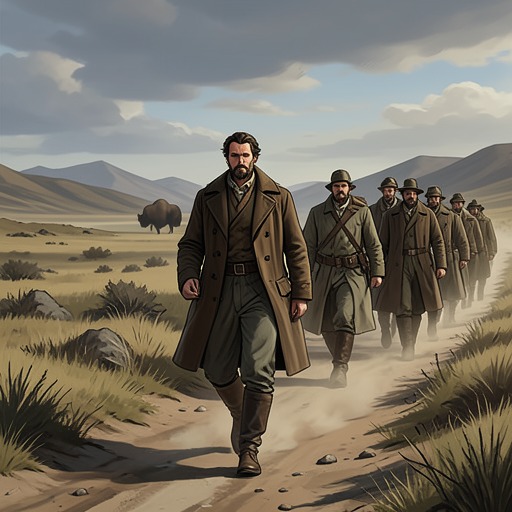
Miller leads the party into the mountains and recognizes the valley when they reach a stretch of river that looks no different from the surrounding landscape. His practiced eye, rather than any conspicuous landmark, identifies the route. Once hunting begins, he teaches Andrews where to aim and explains the tactical importance of killing the herd’s leader first. A leaderless herd, he says, has difficulty moving far in a coordinated direction. The instruction reveals how closely his knowledge serves the mechanics of killing.
Miller’s method turns that knowledge into a sustained campaign. After bringing down the leader, he shoots repeatedly as the animals circle in confusion, and the work of shooting and skinning falls on the whole party. He eventually makes his intention explicit: he will not leave while any bison remains. Schneider challenges the plan, warning that Miller cannot kill every bison in the country. Miller refuses discussion and insists that the expedition is his and that he has already decided. His authority over the hunt overrides the objections of the men who must help process its consequences.
The labor becomes a punishing rhythm. Andrews and Schneider skin animals until dark and rise before dawn to cut apart carcasses stiffened overnight, while Miller’s rifle continues to sound through the day. He grows still at camp, his face darkened by gunpowder that he no longer washes away. The herd dwindles among its own exposed carcasses, and the surviving animals graze through blood-stained grass. Andrews understands that Miller will stay until the last animal is dead; his sense of time shifts from counting days to judging how many bison remain. The world beyond the valley—including the plains, the mountain pass, and Butcher’s Crossing—recedes from his memory. The valley becomes the place by which he imagines his own existence taking shape.
When the remaining bison divide into ten or twelve herds and try to escape, Miller rides back to demand help. He positions Andrews and Schneider on opposite sides and takes the middle, directing them to fire at any herd that approaches so it will change course. Schneider wants to let the animals go; Miller instead tries to drive them back into the valley. His response makes the goal unmistakable: preserving the hunt’s completion matters more than allowing the survivors to escape.
Winter, Return, and the Collapse of the Hunt’s Purpose
The expedition is trapped in the valley by snow. Schneider says he intends to return home, but Miller proposes waiting and preparing for another storm. He chooses a site in the trees for a shelter, reasoning that an exposed structure could not survive a blizzard. The party’s winter survival depends on the same decisive authority that has kept it hunting: Miller assesses conditions and gives the order, while the others endure the consequences together.
The return journey destroys the hides they have spent the winter collecting. As the wagon disappears, Miller describes the loss as a winter’s work gone in two minutes. Yet he still insists, when the party reaches Butcher’s Crossing, that they have three thousand first-rate winter hides hidden in the mountains, worth more than ten thousand dollars even after transport. His confidence rests on the earlier agreement with J.D. McDonald, who had promised four dollars per winter hide.
That agreement no longer has value. J.D. McDonald explains that demand for bison fur has disappeared: buyers who wanted it have already bought what they needed, just as the market for beaver hats collapsed when fashion changed. The hides Miller has risked so much to obtain are now nearly unsalable. The arriving railroad sharpens the irony. Hunters are selling bison meat to the railway company while leaving hides to rot in the sun; Miller’s hunt has destroyed animals whose meat could have earned money, while the product he pursued has lost its buyers. The valley’s slaughter and the market’s reversal are linked, but the market gives no reward for Miller’s persistence.
Burning the Hides and Narrative Significance
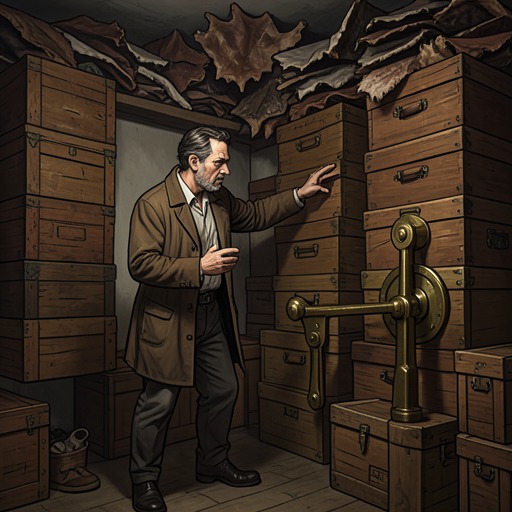
Miller’s response is not to recover the pelts but to burn them. He rides his horse toward the stacked bales beside the burning shelter, pushing them into the flames or driving isolated bales forward with the animal’s chest. The horse is exhausted, and Miller emerges blackened by smoke, with burned hair and a blister rising across his forehead. Charley Hoge tells Andrews to let Miller continue: it is Miller’s fire. The scene gives Miller’s destruction a starkly personal form. The hides that were supposed to convert the slaughter into wealth become fuel for an act that cannot restore the herd or undo the work.
Afterward, Miller looks at Andrews without seeming to recognize him, then rides away into the dark. Andrews remains behind, his arm still raised after the horse strikes his shoulder; Charley Hoge follows Miller, and J.D. McDonald also leaves. Miller’s departure offers no reconciliation or explanation. Throughout his arc, competence and command have enabled him to find the valley, organize the hunt, and survive the winter, but they have not given him power over the market or the consequences of his own purpose. His final separation from Andrews completes the movement from discovery to possession, from possession to destruction, and from destruction to an absence that cannot be repaired.